


Honda
Super-N
Honda has re-entered the electric car arena with the launch of the stylish, fun and funky Super-N city car. It may be small in stature but it’s big on appeal with lots of tech, a spacious cabin and entertaining driving manners.
The good
Charming design, well equipped, practical, easy to drive and very attractive pricingThe bad
ride is quite firm and lots of competition in the A segmentTech Specs


Test Drive
Honda Super-N – First Drive (2026)
Honda has returned to the electric car scene with a fun, funky and rather charming little city car called the Super-N that takes its inspiration from the 1983 Honda City Turbo II, and then runs with it.
Since the e and e:Ny1 were withdrawn from Honda’s ranks, it left the manufacturer without an electric car in its armoury, but that is all changing with the arrival of the Super-N. And customers will be delighted to hear it is attractively priced at £18,995 with some very tempting finance deals too.
The five-door, four-seater will be sold in just one generously-equipped trim called Advance, and there is a single 29.6kWh battery that delivers 128 miles between charges, increasing to a respectable 199 miles in city environments.
It boasts a design that really grabs the attention of any onlooker. It would seem city car designers have been given a completely blank canvas to work with these days and we absolutely love that. It means that we’re suddenly seeing some really charming little creations, such as the new Renault Twingo that will be coming out early next year, the BYD Dolphin Surf, and now the all-new Honda Super-N enters the mix.
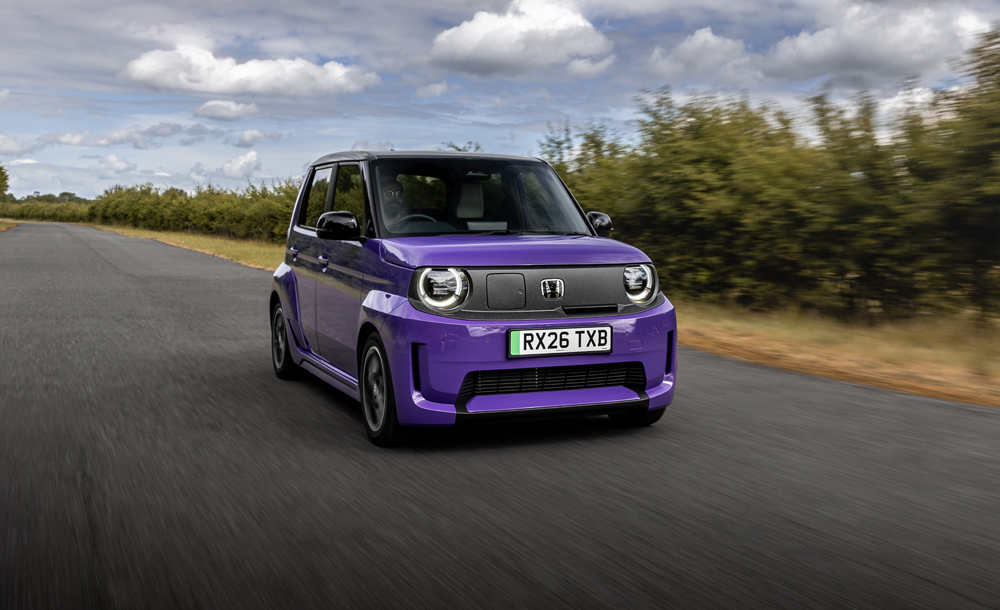
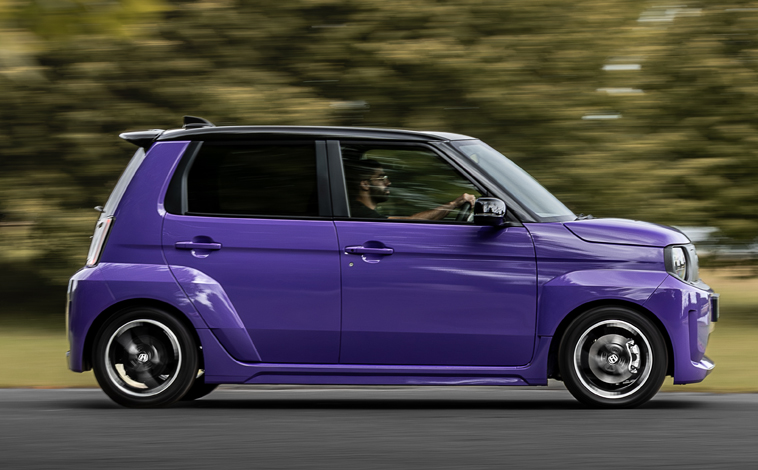
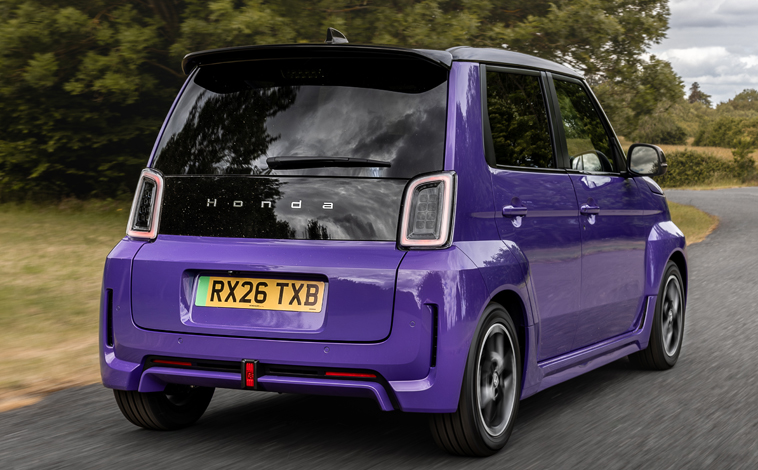
With a nod to the 1980s City Turbo II, you will find circular headlights, a gloss black grille housing a concealed charging port and a wide bumper that accentuates the car’s width. There are flared wheel arches and attractive 15-inch alloys with a two-tone finish. Moving to the rear, you will find neat tail lights, an F1-inspired single fog lamp, a rear spoiler and the Honda name spelt out proudly across the tailgate.
And at a time when everything seems rather grey in the colour palette for new cars, Honda is offering its Super-N in some lovely bright colours, including a Signature Boost Violet pearl shade which featured on our test car and certainly turned some heads.
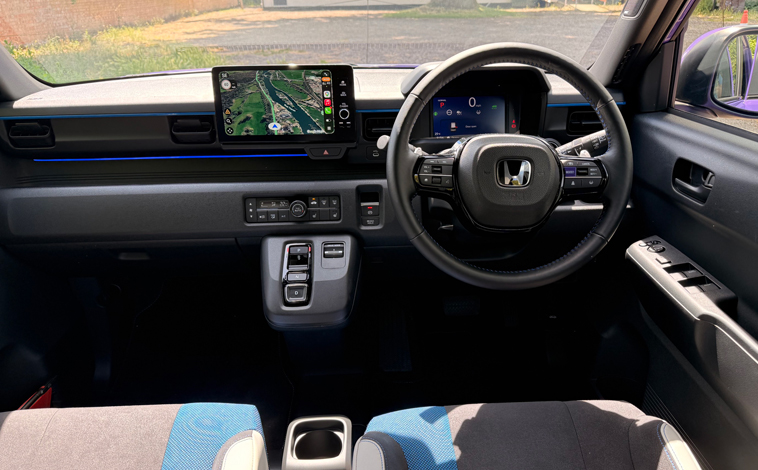
Moving inside, designers have cleverly made the most of the available cabin space and, despite a simplistic layout, there are some neat styling cues, including neat blue piping stretching the length of the dash which matches the stitching on the steering wheel.
The seats have been upholstered in a blue grey material that has been crafted from recycled materials. They are comfortable, and along with the steering wheel, can be heated against the winter chill. The main focal point is a nine-inch infotainment touchscreen sitting high up in the centre of the dash and this is the car’s nerve centre offering access to the many onboard creature comforts.
Although there is no sat nav, most owners nowadays use their smartphone to hook up to any navigational directions, which is a simple task inside the Super-N with Apple CarPlay and Android Auto. Additionally, you will find a DAB radio, reversing camera, Bluetooth and a wealth of other features. But the halo feature here is a pitch perfect Bose sound system which is incredibly high-end for a cost-effective model in the A sector, such as the Honda Super-N. It comes with eight speakers and includes a 20cm subwoofer that fits into a bespoke compartment beneath the boot floor.
Behind the steering wheel is a smaller seven-inch information screen displaying the speed, battery charge levels and existing driving range. And all the climate controls are located in a separate panel for added convenience. It’s so frustrating having to navigate over-complicated touchscreen menus for a simple adjustment such as lowering the temperature – thankfully that’s not the case inside this ultra-user-friendly Super-N model.
When it comes to performance, it’s worth remembering the Super-N is geared towards city lifestyle with is 29.6kWh battery driving a 47kW front e-axle. It can complete the 0-62mph dash in 14.5 seconds and tops out at 84mph. But, this car has a trump card to play by means of a purple BOOST button located on the steering wheel. Press this and the power increases to 70kW and 4.5 seconds is shaved off the 0-62mph sprint time.
Additionally, a seven-speed simulated gearbox comes into play and the paddles, which are generally used to adjust the strength of the regenerative braking, control the gear shifts. There is also an Active Sound Control set-up that mimics the note from a traditional engine and this is particularly effective as the sound plays through the excellent Bose speakers.
The Super-N can sit comfortably at 70mph on dual carriageways and is confident when fizzing through twisting country lanes, but it’s most at home in busier stop, start traffic. Drivers will also notice an increase in range up to 199 miles in city settings where more energy is captured during braking.
Drive modes called Econ, City, Normal, Sport and BOOST alter the dynamics of the car and a single-pedal driving function is automatically activated in City mode, meaning the vehicle can be brought to a complete standstill without touching the brake pedal.
The handling is agile with nicely weighted steering and our only criticism was the ride quality. It’s quite firm and this is especially noticeable in the front passenger seat which lacks any height adjustment. This is rather disappointing as the suspension has been fine-tuned for European and UK roads.
An area where the Super-N really surprises is practicality and versatility. That’s because the cabin is deceptively spacious and the four seats can actually accommodate adults with ease. The car is a fraction shy of 3.6 metres in length and offers decent storage facilities too with the boot, accessed via a manually-operated tailgate, able to hold 162 litres of kit. Drop the two individual rear seats and that limit increases to 967 litres – we reckon you could transport a standard sized washing machine in the back. Additionally, the car features Honda’s clever Magic Seats which means the cushions on the rear seats can be lifted creating a deeper storage area which is ideal for an e-scooter or golf clubs.
There is a small storage compartment beneath the boot floor and a number of handy options throughout the cabin, including a glovebox, single seat back pocket, a dashboard tray, two USB-C ports and five cup or bottle holders.
Charging the Super-N’s battery via a public facility is simple enough with a 15 to 80 per cent increase taking just 30 minutes using a 50kW outlet. But it will be cheaper to charge up at home or work where a 0 to 100 per cent boost takes four hours via a 7.4kW outlet or three if using an 11kW port.
Although the Super-N has not been tested for a Euro NCAP safety rating it is packed with features, such as an advanced post-collision mitigation braking system, collision mitigation braking with forward collision warning system, adaptive cruise control, road departure mitigation system, lane keep assist, traffic sign recognition, traffic jam assist, plus a full suite of airbags.
To sum up, it’s a really exciting time for Honda with the launch of the Super-N and it’s a vitally important car for the company too. With that in mind, they are targeting 70 per cent conquest sales, although they will face tough opposition from the likes of the upcoming new Renault Twingo, BYD Dolphin Surf, Citroen e:C3 and several others. In fact, the electric A-segment is becoming quite a fiercely competitive arena these days, so only time will tell for the Super-N.